

The neuroscience of defending our mistakes and the self-discipline required to change direction.
By Martin Ferreira | Thrive with Martin
One of the greatest obstacles to personal growth is not our inability to make good decisions, but our unwillingness to acknowledge when we have made bad ones.
We have all witnessed someone make a questionable decision, defend it despite overwhelming evidence, and then continue making increasingly poor decisions in an attempt to validate their original choice. Perhaps, if we are willing to examine ourselves honestly, we have been that person.
This behavior can destroy relationships, businesses, careers, financial security, physical health, and personal integrity.
What begins as a simple error in judgment can become a behavioral pattern in which protecting the ego becomes more important than improving the outcome.
Why do otherwise intelligent people fall into this trap? Why do we sometimes work harder to defend a mistake than we do to correct it?
The answers can be found in psychology, behavioral science, and neuroscience.
1. Cognitive Dissonance: The Battle Between Belief and Reality
In 1957, psychologist Leon Festinger introduced the theory of cognitive dissonance.
Cognitive dissonance describes the psychological discomfort we experience when our beliefs, behaviors, and understanding of reality contradict one another.
Imagine that you consider yourself an intelligent, responsible individual who exercises good judgment. You make an important decision, only to discover that it was a poor one.
You are now confronted with two conflicting thoughts:
- I am someone who makes intelligent decisions.
- I have made a decision that was not intelligent.
This creates psychological tension. To reduce that tension, we can either acknowledge our mistake and adjust our behavior or reinterpret reality to make our decision appear reasonable.
Unfortunately, the second option can feel easier in the moment.
We begin making excuses, minimizing consequences, blaming circumstances, questioning the intentions of others, or selectively interpreting information.
Rather than correcting our behavior, we change the narrative surrounding it.
The danger is that the relief we experience from justifying our actions can come at the expense of our long-term well-being.
Feeling better about a decision does not make it a better decision.
2. Escalation of Commitment: Digging the Hole Deeper
In 1976, organizational psychologist Barry M. Staw published a foundational study titled Knee-Deep in the Big Muddy: A Study of Escalating Commitment to a Chosen Course of Action.
His research examined why individuals continue committing resources to decisions that have already produced unfavorable outcomes.
Using a simulated business investment exercise involving 240 participants, Staw investigated how personal responsibility and negative outcomes influenced subsequent investment decisions.
His research helped establish that people can become increasingly committed to a failing course of action, particularly when they feel personally responsible for the original decision.
This phenomenon is known as escalation of commitment.
We see examples of it throughout everyday life:
- A business owner continues funding an unsuccessful venture without correcting its fundamental problems.
- An individual remains in a destructive relationship because admitting they chose poorly feels unbearable.
- A person tells a lie and then tells additional lies to protect the original one.
- An investor increases their financial exposure primarily to avoid acknowledging a previous loss.
- A leader implements increasingly ineffective policies to defend an earlier decision.
- An individual distances themselves from friends who challenge their behavior and surrounds themselves with people who validate it.
Every additional decision creates another layer of psychological investment.
Eventually, the individual is no longer simply defending the original decision. They are defending an entire history of choices built upon it.
The longer this continues, the more difficult accountability becomes.
The first mistake may have been an error in judgment. The subsequent mistakes may be attempts to avoid accountability for it.
3. The Sunk Cost Fallacy: Sacrificing the Future to Justify the Past
In 1985, psychologists Hal Arkes and Catherine Blumer published The Psychology of Sunk Cost.
Their research demonstrated that people are more inclined to continue an endeavor after investing money, time, or effort in it, even when that previous investment should not determine the best future course of action.
This is known as the sunk cost fallacy.
Consider how frequently we hear statements such as:
- I’ve already spent too much money to quit.
- I’ve invested too many years in this relationship.
- I’ve worked too hard to change direction now.
- If I walk away, everything I’ve done will have been for nothing.
- I have to prove that I made the right choice.
The problem with this reasoning is that the past cannot be recovered simply by making additional sacrifices.
If you have wasted five years pursuing the wrong objective, investing another five years will not automatically make the first five worthwhile.
This does not mean that we should abandon difficult endeavors. Perseverance is an essential component of success.
However, perseverance must be guided by evidence, realistic expectations, and a worthwhile objective.
There is a fundamental difference between enduring hardship in pursuit of growth and enduring hardship because we refuse to acknowledge an error.
Never sacrifice your future simply to justify your past.
4. Confirmation Bias and Motivated Reasoning
Once we become emotionally invested in a decision, we can begin filtering information in ways that support our preferred conclusion.
Confirmation bias is our tendency to seek, interpret, and remember information that reinforces our existing beliefs.
Motivated reasoning takes this further. Our desired conclusion can influence how we evaluate evidence and construct arguments.
Instead of asking what is true, we begin searching for reasons why we must be right.
We may dismiss legitimate criticism, exaggerate evidence that supports our position, or apply different standards of judgment to ourselves than we apply to others.
Intelligence does not necessarily protect us from this phenomenon.
An intelligent individual may simply possess a greater ability to construct sophisticated arguments defending a poor decision.
Our ability to explain something does not establish its validity.
Ask yourself:
Am I using my intelligence to discover the truth, or am I using it to protect myself from the truth?
The distinction is essential to intellectual honesty and personal development.
5. The Neuroscience Behind Self-Justification
Self-justification is not merely a philosophical concept. Researchers have identified patterns of brain activity associated with cognitive dissonance and rationalization.
A 2009 study published in Nature Neuroscience by Vincent van Veen and colleagues used functional magnetic resonance imaging, or fMRI, to investigate cognitive dissonance.
The researchers identified activity in two notable brain regions.
The dorsal anterior cingulate cortex
This region is involved in several cognitive functions, including monitoring conflict and detecting discrepancies that may require adjustments in behavior.
When our actions conflict with our beliefs, this region can participate in processing that conflict.
The anterior insula
The anterior insula participates in emotional processing, awareness of internal bodily states, and the experience of unpleasant feelings.
In the study, activity in these two regions was associated with subsequent changes in participants’ attitudes.
A separate study by Jarcho, Berkman, and Lieberman, published in 2011, investigated the neurological processes associated with rationalization during decision-making.
Their findings suggested that rationalization-related processes may begin during the decision itself, rather than resulting exclusively from later conscious deliberation.
These studies illustrate an important principle: we may begin adjusting our interpretation of a situation before we become consciously aware that we are doing so.
However, neuroscience does not suggest that we are powerless against these tendencies. Nor does it establish that a single brain region is responsible for self-deception.
It provides insight into the processes we must become aware of and learn to regulate.
Awareness creates an opportunity to interrupt automatic patterns and respond more deliberately.
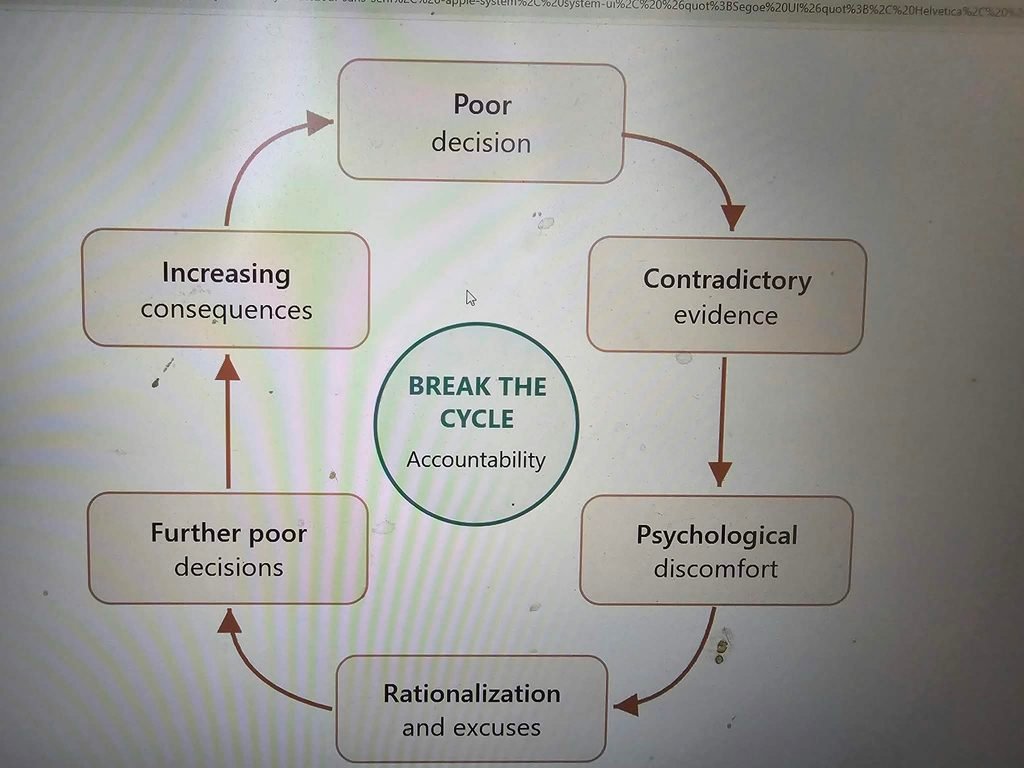
6. The Destructive Cycle of Self-Justification
The cycle often develops in the following manner:
- We make a poor decision.
- Evidence emerges that challenges our choice.
- We experience psychological discomfort.
- We create a justification to reduce that discomfort.
- We selectively accept information that supports our justification.
- We make additional commitments to validate the original choice.
- Negative consequences accumulate.
- We develop stronger justifications to defend our growing investment.
The cycle can continue until the consequences become impossible to ignore or until we develop the self-awareness and courage necessary to interrupt it.
One of the most damaging aspects of this process is that we can begin viewing the people who challenge our decisions as the source of our discomfort.
Rather than recognizing the value of their perspective, we interpret their honesty as hostility.
We may even remove the very people from our lives who are capable of helping us grow.
Over time, we can create an environment in which our decisions are consistently validated but rarely challenged.
That is not personal development. It is an environment that protects us from it.
7. Recognizing the Warning Signs in Yourself
Self-awareness begins with examining our own behavior rather than becoming experts at identifying the faults of others.
Consider whether you recognize any of these patterns:
- You become emotionally defensive when someone questions your decisions.
- You repeatedly explain your intentions rather than examine your results.
- You blame others for the predictable consequences of your choices.
- You change your explanation whenever new evidence contradicts it.
- You avoid people who challenge your perspective.
- You surround yourself with individuals who tell you what you want to hear.
- You continue investing in something primarily because you have already invested so much.
- You are more concerned with proving someone wrong than improving the situation.
- You cannot identify any evidence that would cause you to reconsider your position.
- You frequently confuse admitting a mistake with personal failure.
None of these behaviors alone proves that someone is engaged in self-deception. However, recurring patterns deserve examination.
One particularly revealing question is:
If I were not personally responsible for this decision, would I still believe it was the best course of action?
Creating psychological distance between ourselves and our decisions can help us evaluate them more objectively.
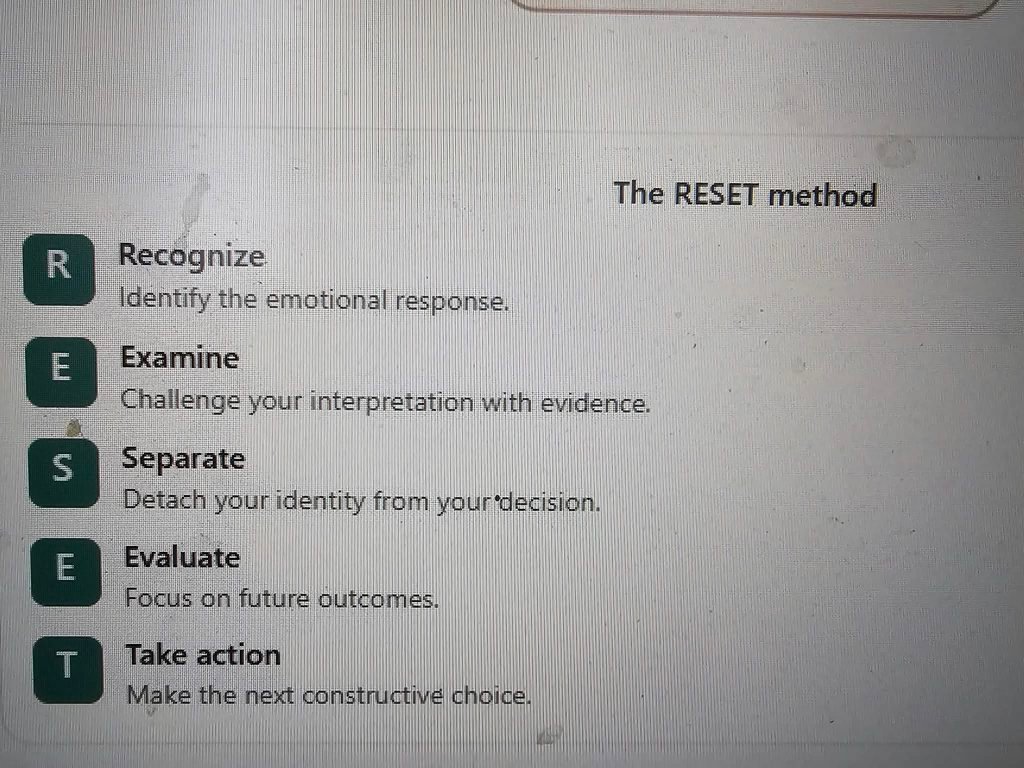
8. Breaking the Cycle: The RESET Method
The following five-step exercise is a practical coaching framework for developing greater self-awareness, intellectual honesty, and decision-making discipline.
R — Recognize the emotional response
Notice when criticism, disagreement, or contradictory evidence produces an unusually strong emotional reaction.
Before responding, identify the emotion.
Is it embarrassment? Anger? Shame? Fear of rejection? Fear of appearing incompetent?
Recognize that emotional discomfort is information about your internal experience, not necessarily evidence that the other person is wrong.
E — Examine the evidence
Separate what you know from what you believe, assume, hope, or fear.
Write down the observable facts.
Actively search for evidence that contradicts your preferred conclusion.
In 1984, researchers Charles Lord, Mark Lepper, and Elizabeth Preston demonstrated that deliberately considering opposing possibilities could reduce certain biases in social judgment.
Instead of simply asking yourself to be objective, make a deliberate effort to construct the opposing argument.
Ask:
What evidence would convince me that I am wrong?
If the answer is nothing, you may be defending a belief rather than evaluating a decision.
S — Separate your identity from your decision
You are not your mistakes.
Making a poor decision does not establish that you are unintelligent, incapable, or unworthy of respect.
Your character is demonstrated not only through your original choices but through your willingness to accept responsibility when those choices produce undesirable consequences.
Replace the need to say, “I am right,” with the commitment to say, “I am willing to learn.”
This is not lowering your standards. It is raising them.
E — Evaluate the future, not the past
Imagine that you are encountering your current situation for the first time, with no previous emotional, financial, or personal investment.
Knowing everything you know today, would you make the same choice?
If the answer is no, examine what is preventing you from changing direction.
Evaluate the realistic future benefits, costs, risks, and available alternatives.
When pursuing a difficult goal, establish measurable progress indicators and predetermined conditions for reassessment.
This allows persistence to be guided by evidence rather than emotional attachment.
T — Take corrective action
Awareness without action is insufficient.
Corrective action may require apologizing, changing a strategy, ending an unhealthy commitment, seeking professional guidance, repairing damage, or acknowledging that someone else’s perspective was more accurate than your own.
Begin with the next constructive decision.
You cannot change the decision you made yesterday, but you can change whether you continue repeating it tomorrow.
9. The Difference Between Discipline and Stubbornness
Through more than four decades of teaching martial arts, I have come to appreciate the importance of recognizing the difference between persistence and rigidity.
Imagine a martial artist practicing a technique incorrectly thousands of times.
No matter how much discipline, determination, or effort that student possesses, repetition alone will not correct the underlying error. It may simply make the incorrect movement more habitual.
Progress requires feedback, adjustment, and the humility to recognize that our current method may not be producing the desired result.
Life operates in much the same way.
Discipline is remaining committed to a worthwhile objective while being willing to improve your methods.
Stubbornness is remaining committed to your methods even when they repeatedly prevent you from achieving your objective.
Self-mastery requires the ability to distinguish between the two.
We must have the courage to endure necessary hardship, but also the wisdom to recognize unnecessary suffering.
10. A Personal Accountability Exercise
Identify one decision in your life that has been producing disappointing or destructive results.
Take out a notebook and answer the following questions honestly:
- What was my original decision?
- What information did I have when I made it?
- What new information has become available since then?
- Are my current results consistent with my original expectations?
- What excuses or justifications have I repeatedly used?
- Have I made additional poor decisions to defend the original one?
- What has this pattern cost me financially, physically, emotionally, or relationally?
- What advice would I give someone I cared about in the same situation?
- What am I afraid will happen if I admit I was wrong?
- What constructive action can I take within the next 24 hours?
Repeat this exercise periodically.
The objective is not to criticize yourself for every imperfect decision. It is to develop a more accurate understanding of your behavior and increase your ability to respond constructively.
Final Thoughts: Choose Growth Over Being Right
There is no shame in discovering that something you once believed was incorrect.
Our understanding of the world should evolve as our knowledge and experience increase.
A decision may have been reasonable based on the information available at the time. However, continuing to defend that decision after receiving compelling contradictory evidence is an entirely different matter.
We cannot expect to grow while demanding that every previous version of ourselves be proven right.
There is strength in saying:
I was wrong.
I understand why I made that decision.
I accept responsibility for its consequences.
I am prepared to change.
The greatest demonstration of intelligence is not the ability to justify every decision we have ever made. It is the ability to recognize when our understanding is incomplete and adjust accordingly.
The greatest demonstration of confidence is not the insistence that we are always right. It is the ability to acknowledge that we are wrong without losing our sense of self-worth.
And the greatest demonstration of self-mastery is the ability to choose truth over comfort, accountability over excuses, and growth over ego.
Do not become so committed to proving that your past decisions were right that you destroy your opportunity to make better ones in the future.
Your past deserves reflection, your present demands accountability, and your future deserves wisdom.
Keep learning. Keep evolving. Keep thriving.
Martin Ferreira — Thrive with Martin
Scientific References and Further Reading
- Festinger, L. (1957). A Theory of Cognitive Dissonance. Stanford University Press.
- Staw, B. M. (1976). Knee-deep in the big muddy: A study of escalating commitment to a chosen course of action. Organizational Behavior and Human Performance, 16, 27–44. Read the research.
- Arkes, H. R., & Blumer, C. (1985). The psychology of sunk cost. Organizational Behavior and Human Decision Processes, 35, 124–140. Read the research.
- Brockner, J. (1992). The escalation of commitment to a failing course of action: Toward theoretical progress. Academy of Management Review, 17, 39–61. Read the research.
- Kunda, Z. (1990). The case for motivated reasoning. Psychological Bulletin, 108, 480–498. Read the research.
- van Veen, V., Krug, M. K., Schooler, J. W., & Carter, C. S. (2009). Neural activity predicts attitude change in cognitive dissonance. Nature Neuroscience, 12, 1469–1474. Read the research.
- Jarcho, J. M., Berkman, E. T., & Lieberman, M. D. (2011). The neural basis of rationalization: Cognitive dissonance reduction during decision-making. Social Cognitive and Affective Neuroscience, 6, 460–467. Read the research.
- Lord, C. G., Lepper, M. R., & Preston, E. (1984). Considering the opposite: A corrective strategy for social judgment. Journal of Personality and Social Psychology, 47, 1231–1243. Read the research.
Recommended Reading: Expand Your Understanding
At Thrive with Martin, I believe that personal development is a lifelong commitment to education, self-awareness, and the continuous refinement of our character.
Understanding why we behave the way we do is an important first step toward developing self-mastery. However, knowledge becomes truly valuable when we apply it to our daily lives.
If this article has encouraged you to examine your own decision-making patterns, I recommend the following three books to deepen your understanding.
Disclosure: The following recommendations contain affiliate links. I may earn a commission from qualifying purchases at no additional cost to you.
1. Mistakes Were Made (But Not by Me): Why We Justify Foolish Beliefs, Bad Decisions, and Hurtful Acts
By Carol Tavris and Elliot Aronson
Why do we find it so difficult to admit when we are wrong?
This outstanding book explores the psychological mechanisms behind cognitive dissonance, self-justification, and the human tendency to protect our self-image, even at the expense of truth and accountability.
The authors demonstrate how seemingly insignificant mistakes can develop into increasingly destructive patterns when we refuse to acknowledge them.
I recommend this book to anyone seeking to better understand human behavior, improve personal relationships, and develop greater emotional maturity and personal accountability.
2. Thinking, Fast and Slow
By Daniel Kahneman
Nobel Prize-winning psychologist Daniel Kahneman explores the two broad modes of thinking that influence our judgment and decision-making.
Through decades of research, Kahneman examines cognitive biases, overconfidence, emotional influences, and the mental shortcuts that can lead us toward irrational conclusions.
This book provides a valuable foundation for understanding why intelligence alone does not guarantee good judgment and why developing greater awareness of our thinking processes is essential to personal growth.
3. Think Again: The Power of Knowing What You Don’t Know
By Adam Grant
One of the most valuable skills we can develop is the willingness to reconsider what we believe.
Organizational psychologist Adam Grant explores the importance of intellectual humility, cognitive flexibility, and the ability to unlearn outdated beliefs.
Rather than viewing a change of mind as a sign of weakness, Grant encourages us to recognize it as an opportunity for learning and growth.
This book is an excellent companion to the RESET method introduced in this article and reinforces one of the fundamental principles of self-mastery: our commitment to discovering the truth must be greater than our desire to be right.
A Final Challenge
Do not simply read these books to understand the mistakes other people make. Read them to recognize the patterns within yourself.
Choose one concept from each book and deliberately incorporate it into your daily life.
The accumulation of knowledge is education. The application of knowledge is growth. The consistent application of knowledge is the path toward self-mastery.
As the Stoic philosopher Seneca reminds us:
“As long as you live, keep learning how to live.”
Keep learning. Keep evolving. Keep thriving.
Martin Ferreira
Thrive with Martin
Amazon Affiliate Disclosure
As an Amazon Associate I earn from qualifying purchases.
Some links within this article are affiliate links. If you make a qualifying purchase through one of these links, I may receive a commission at no additional cost to you.
The books and resources recommended through Thrive with Martin are selected for their educational value and relevance to personal development, self-mastery, and lifelong learning.
Your support helps sustain Thrive with Martin and allows me to continue creating educational articles, resources, and tools designed to help individuals develop their full potential.
Thank you for supporting our mission.