
Every school has traditions.
Some are simply rituals repeated because “that’s how we’ve always done it.”
Others carry a lesson that becomes more valuable the longer you train.
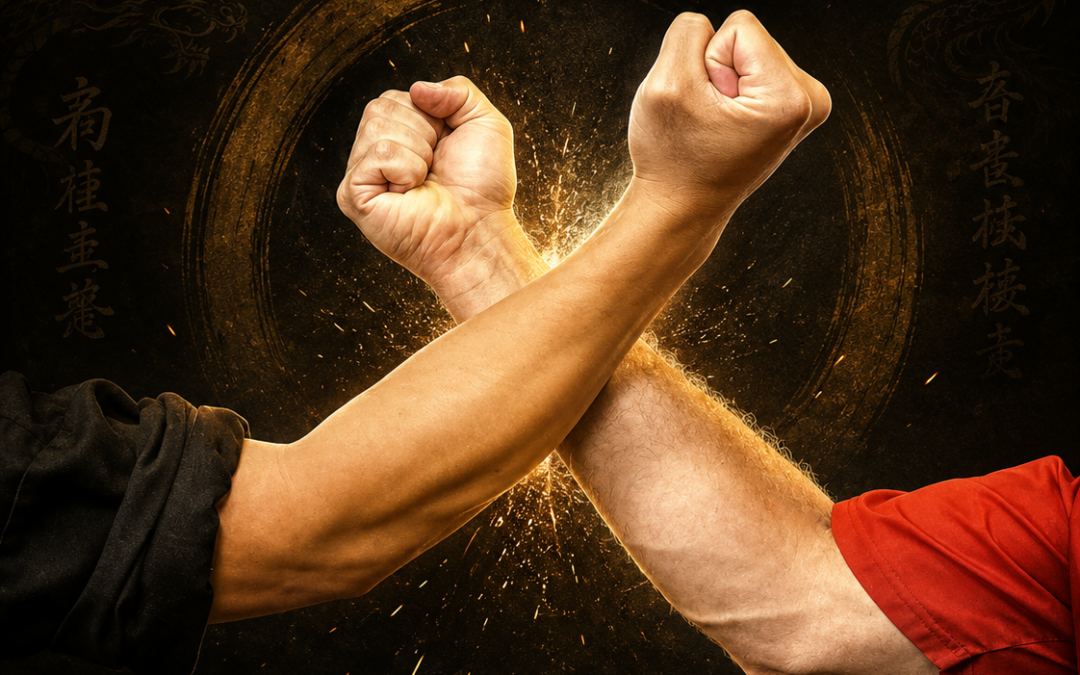
At Five Pillars Martial Arts DBA White Dragon of East County, when we greet one another, we don’t simply shake hands. We shake hands, and then we clash our forearms.
To many, it looks like a martial arts greeting.
To us, it is a promise.
It is a reminder that we are here to sharpen one another.
The roots of this tradition reach far deeper than martial arts. The ancient proverb from Proverbs 27:17 states:
“As iron sharpens iron, so one person sharpens another.”
Iron does not become sharp by lying next to another blade.
It becomes sharp through friction.
Pressure.
Resistance.
Contact.
The very things most people spend their lives trying to avoid.
Human beings are no different.
None of us become stronger because everyone agrees with us.
None of us develop wisdom because everyone tells us we’re right.
None of us build resilience by surrounding ourselves with comfort.
Growth requires friction.
It requires people willing to challenge us, question us, expose our blind spots, and hold us accountable when our ego begins to take control.
The clash of our forearms symbolizes exactly that.
It says:
“I will make you better, and I give you permission to make me better.”
That is a sacred agreement.
Choose Your Iron Carefully
There is another lesson hidden inside this proverb that is often overlooked.
Iron sharpens iron.
Iron does not sharpen wood.
Nor does it sharpen clay.
The quality of what sharpens you matters.
One of the greatest decisions you will ever make is deciding who you allow into your inner circle.
Your friends.
Your mentors.
Your instructors.
Your training partners.
Your spouse.
Your business partners.
Every one of them is either sharpening you…
…or slowly dulling your edge.
Character is contagious.
So is mediocrity.
Strength spreads.
Weakness spreads.
Discipline spreads.
Excuses spread even faster.
We often hear the phrase:
“Show me your friends, and I’ll show you your future.”
There is profound truth in that statement.
If you spend enough time around people who avoid responsibility, eventually responsibility begins to feel optional.
Spend enough time around people who blame others, and blaming becomes normal.
Spend enough time around people who pursue excellence, and excellence becomes your standard.
We become the environment we repeatedly expose ourselves to.
Discernment Is Not Exclusion
Modern society often confuses discernment with judgment.
It teaches that everyone must be included in every aspect of our lives regardless of the influence they bring.
But inclusion and proximity are two different things.
Every person deserves dignity.
Every person deserves respect.
Not every person should influence your mind.
Not every person belongs in your inner circle.
Discernment is not arrogance.
It is wisdom.
If you wanted to become a world-class musician, would you seek lessons from someone who has never played?
If you wanted to become physically strong, would you hire a trainer who never trains?
Then why do people seek advice about life from individuals who have never developed discipline, integrity, courage, or emotional maturity?
The people closest to you shape your thinking long before you realize it.
Choose carefully.
Not because others have less value as human beings.
But because your future depends upon what repeatedly influences your mind.
Beware of Comfortable Mirrors
One of the greatest dangers today is that we can create an environment where our beliefs are never challenged.
Social media algorithms feed us what we already agree with.
Our phones learn what we like.
Our news confirms our opinions.
Even artificial intelligence can become nothing more than an obedient servant to our ego.
If your prompts are written only to validate what you already believe, AI will often do exactly that.
It becomes another comfortable mirror.
But mirrors do not sharpen us.
Resistance does.
The quality of the answer depends greatly upon the quality of the question.
If you seek validation, you will usually find it.
If you seek truth—even when it is uncomfortable—you have a chance to grow.
Throughout my own use of AI, I have found that its greatest value comes when I intentionally ask it to challenge my assumptions, expose weaknesses in my reasoning, and present perspectives I may not want to hear.
The lesson is the same whether the source is a training partner, a mentor, a book, or a machine:
Never seek comfort when you should be seeking truth.
The Courage to Be Corrected
The ego hates correction.
It wants applause.
Agreement.
Recognition.
Growth requires something entirely different.
Humility.
Humility is not thinking less of yourself.
It is caring more about truth than about being right.
Every correction is an opportunity.
Every difficult conversation can reveal a weakness.
Every failure points toward a future strength.
The student who cannot be corrected has already stopped learning.
The instructor who cannot be corrected has already begun declining.
The strongest people I have ever known were also the easiest to coach.
Why?
Because their identity was never attached to appearing perfect.
It was attached to becoming better.
The Loneliness of the Higher Road
I have chosen this path my entire life.
It has not always been easy.
There have been seasons when choosing growth meant walking away from relationships that no longer challenged me.
There have been moments when pursuing truth was far lonelier than accepting comfort.
There have been times when standing for discipline cost me friendships.
There have been moments when accountability was mistaken for judgment.
I have learned that excellence is often a quieter road.
But I would not trade it for anything.
The lessons.
The clarity.
The resilience.
The confidence that comes from knowing your beliefs have survived honest examination rather than emotional protection.
Those things cannot be purchased.
They must be earned.
What the Forearm Clash Means
So the next time we greet one another and our forearms meet, remember what is really happening.
It is not simply tradition.
It is not simply respect.
It is a commitment.
A commitment to becoming stronger together.
To refusing mediocrity.
To embracing correction.
To protecting our character by choosing worthy influences.
To sharpening our minds with truth instead of comfort.
To holding one another to standards that the world increasingly asks us to lower.
Steel does not apologize for becoming sharper.
Neither should you.
Every clash of the forearms is a reminder that we are not here merely to train techniques.
We are here to forge character.
Because when character is forged, courage follows.
When courage follows, leadership emerges.
And when leaders sharpen one another, families become stronger, communities become healthier, and future generations inherit something worth carrying forward.
May you always choose your iron wisely.
And may you have the courage to let it sharpen you.
Sifu Martin Ferreira
Thrivewithmartin.com
whitedragonofeastcounty.com
Thank you for this wonderful kernel of wisdom.